

Quick answer
No laser is best for everyone. The choice depends on your skin tone and hair color.
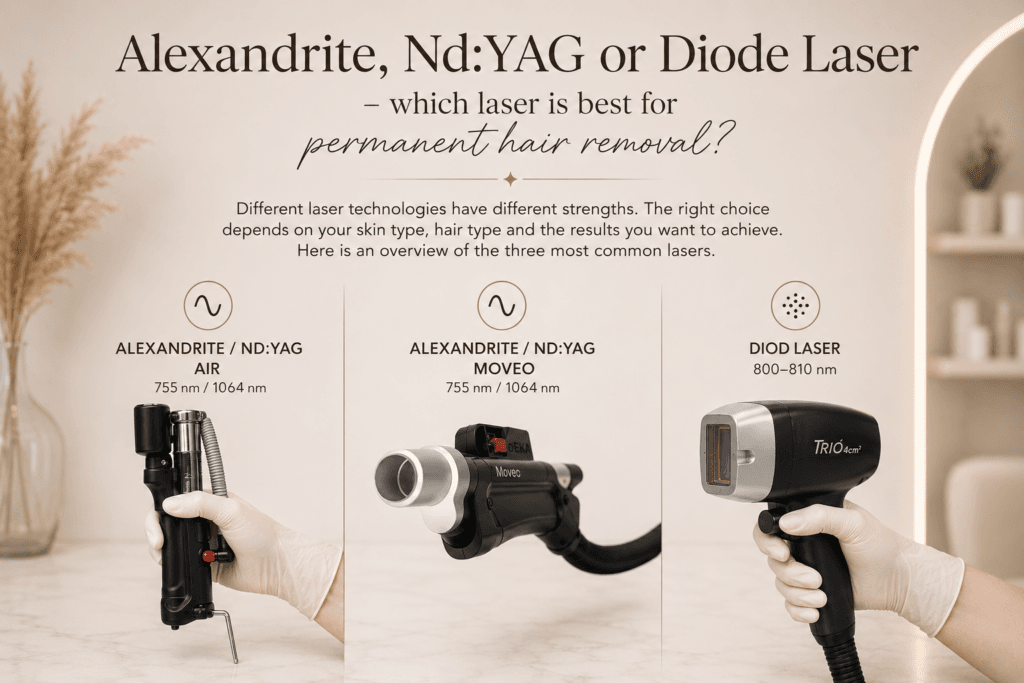
If you start by looking at the different nanometers, i.e. the light used.
- Alexandrite (755 nm) is most effective for fair skin (Fitzpatrick I–III).
- Nd:Yag (1064 nm) is safest and most effective for darker skin tones (Fitzpatrick IV–VI) and tanned skin, where other lasers are risky.
- Diode (810 nm) is the most versatile and works well across a wide range of skin tones (II–V).
There are then two different basic technologies used to project the light onto the skin, electronic-based and crystal-based (so-called “solid state”).
Diode lasers use electronic-based
Advantages: Can treat large areas quickly. Can shoot several nanometers at once. Usually has very good cooling which gives a “gentle” treatment. Is priced far below solid-state lasers and therefore usually provides much cheaper treatments.
Disadvantages: You cannot control which nanometer is used, usually 808 accounts for at least 70% of the light delivery. They are much weaker lasers than crystal-based ones. They are not able to get down to very short milliseconds like a crystal-based laser.
Application: Here the hairs should be freshly shaved or a very small growth 0-1mm. Ultrasound gel is applied to the skin and the laser is delivered via a cooled prism that is either moved back and forth over the skin or with single shots.
Alexandrite and Nd:Yag lasers use crystal-based
Advantages: Mainly because they are stronger and more effective than electronic-based ones. Good solid-state lasers get down to 1-2 milliseconds and are therefore clearly better at treating even, for example, thin and light hairs. You can also choose exactly which nanometer or nanometers are used. Most people experience much better results with this type of laser.
Disadvantages: It is experienced as a more intensive treatment. Here the skin can be affected more and it stings and becomes hotter. It simply hurts a little more. Since the machines are more expensive, the treatments are also usually more expensive.
Application: Here the hairs should be shaved with a short growth of 1-2mm or trimmed to the right length. In most cases, the laser light is delivered at a short distance (3-4cm) from the skin and cold air is used as cooling and shot by shot. At our clinic we call this technology “AiR” but this is what is known as traditional Alexandrite. The exception is machines of the DEKA brand. These also offer so-called “Moveo” technology, i.e. real crystal-based lasers that can deliver the laser light with close-to-skin inmotion (with oil/gel) and super cooling for painless treatments.
The difference between a regular solid-state laser and the absolute top premium lasers
There is standard and premium and then there is PREMIUM+!
Premium: Exclusive premium lasers such as the Candela Gentlemax series, DEKA’s Motus series, Quantas Thunder, Lumenis LightSheer, Splendor X and a few more are among the best lasers in the world and are available at many well-known clinics.
Premium+: However, there are three lasers that are a bit sharper and are used by specialist clinics that demand the absolute best. Candela Gentlemax Pro Plus, DEKA Again Pro Plus and Lumenis Clarity II. These three have a stronger motor which means they can work with larger spot sizes and provide extremely fast and very effective treatments. The one that stands out a little extra here is DEKA Again Pro Plus as it has both AiR and Moveo technology.
The best clinics have several techniques and nanometers and adapt the laser to the individual, not the other way around.
Key points
- Alexandrite, Nd:Yag and Diode are the three laser types used for permanent hair removal in Sweden today.
- IPL is not a laser – it is intense pulsed broad spectrum light and requires more treatments for weaker results.
- 6–10 treatments spaced 4–8 weeks apart are usually required for 80–90% permanent hair reduction.
- Skin and hair pigment determine the result. The laser is absorbed by the melanin in the hair shaft, heating the hair follicle and destroying the growth cells.
- Treatment should be done during the hair’s active growth phase (anagen). This is why multiple sessions are required.
- A clinic with only one laser type cannot offer optimal treatment for all skin tones.
Comparison table: The different laser types and IPL
| Property | Alexandrite AiR | Alexandrite Moveo | Nd:Yag AiR | Nd:Yag Moveo | Diod | IPL |
|---|---|---|---|---|---|---|
| Wave-length | 755nm | 755nm | 1064nm | 1064nm | 808nm (755-1064) | 500-1200nm (wide) |
| Best for skin type (Fitzpatrick) | 1-3 | 1-5 | 4-6 | 5-6 | 2-5 | 1-2 |
| Best for hair type | Light, dark, thin, thick | Light, dark, thin, thick | Dark, medium, coarse | Dark, medium, coarse | Dark, medium, coarse | Dark, coarse |
| Penetration depth | Medium | Medium | Deepest | Deepest | Medium / deep | Superficial |
| Treatment time larger area | Fast | Medium | Medium | Medium | Fast | Slow |
| Pain level | Moderate to high | Low | Moderate | Low | Low | Moderate to low |
| Risk of pigmentation in dark skin | High | Moderate to low | Very low | Very low | Low to moderate | High |
| Average number of sessions / basic course | 6-12 | 6-12 | 8-12 | 8-12 | 8-16 | 8-14 |
| Long-term hair reduction | 80-90% | 80-90% | 80-90% | 80-90% | 75-90% | 50-70% |
Alexandritlaser (755 nm)
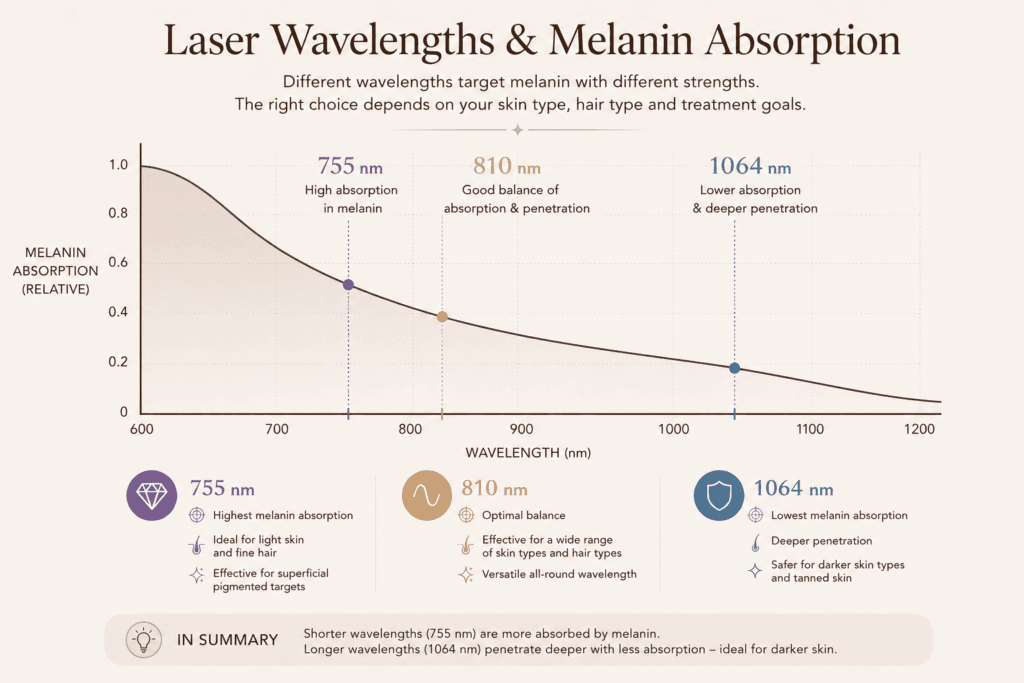
Quick answer: The Alexandrite laser is the gold standard for permanent hair removal on fair skin with dark hair. It works at a wavelength of 755 nm, which is strongly absorbed by the melanin in the hair follicle but minimally by the skin – as long as the skin is fair.
How it works
The Alexandrite laser emits a concentrated beam of light at 755 nm. This wavelength has the highest affinity for the melanin in the hair shaft of all hair removal lasers. The energy is converted into heat that destroys the hair follicle and the stem cells that produce new hair.
The laser is solid-state-based (crystal-based, therefore sometimes called a “crystal laser”) and produces very concentrated pulses. On larger areas such as the legs or back, the treatment is 30–50% faster than with a diode laser.
Who is Alexandrite suitable for
- Skin tone: Fitzpatrick I–III (very light to medium-dark skin that is not tanned) At clinics that have Moveo technology, skin types 4-6 can also be treated.
- Hair color: Light, brown and black. Also works on light hair but less than on darker hair and not at all on white, red or grey hair.
- Areas: All areas, especially effective on thin light hair and stubborn areas.
Limitations
For darker skin (Fitzpatrick IV and above) or tanned skin, the pigment in the skin absorbs too much of the energy, which poses a risk of burns and hyperpigmentation. In this case, use Alexandrite Moveo or Nd:Yag instead.
Nd:Yag-laser (1064 nm)
Quick Answer: Nd:Yag is the only laser that can safely treat dark skin types (Fitzpatrick IV–VI) and tanned skin. It operates at 1064 nm – the longest wavelength among hair removal lasers – allowing the light to penetrate deeper and pass past the melanin in the skin.
How it works
The Nd:Yag laser’s long wavelength is absorbed less by melanin in the skin and more by deeper structures such as the vascular supply of the hair follicle. This means it can be used where other lasers would burn the skin.
Who is Nd:Yag suitable for?
- Skin tone: Fitzpatrick IV–VI (medium to dark skin), tanned skin, light skin in summer
- Hair color: Dark brown to black, medium to coarse hair
- Areas: Entire body, especially beneficial on areas that tan easily (face, neck, décolleté, arms) or where the skin is naturally darker (intimate areas, armpits)-
Limitations
Nd:Yag requires slightly more treatments than Alexandrite on light skin with dark hair, as the wavelength is less absorbed by the melanin in the hair. For light skin with dark hair, Alexandrite is a better choice.
Diodlaser (810 nm)
Quick answer: The diode laser is the most versatile laser and is suitable for a wide range of skin tones (Fitzpatrick II–V). It operates at 810 nm – midway between Alexandrite and Nd:Yag – and combines good efficiency with a wider safety margin.
How it works
The diode laser uses semiconductor technology instead of crystal (Alexandrite) or rod (Nd:Yag). It produces long, continuous pulses that heat the hair follicle gradually rather than with short high energy peaks. Modern diode lasers often have integrated contact cooling that makes the treatment more comfortable.
Who is the diode laser suitable for?
- Skin tone: Fitzpatrick II–V (light to medium skin)
- Hair color: Dark brown to black
- Areas: Large areas where comfort is a priority (legs, back), sensitive areas where less pain is desired.
Limitations
Less effective on Fitzpatrick I (very light skin), and less safe on Fitzpatrick VI compared to Nd:Yag. Is a good intermediate option but rarely the optimal choice.
IPL – why it's not laser and why it's not good enough
IPL stands for Intense Pulsed Light and is not a laser. It is a broad spectrum light source that emits light over wavelengths from approximately 500 to 1200 nm. Filters are used to limit which wavelengths reach the skin.
For hair removal, this means:
- The energy is spread over many wavelengths instead of concentrated at an optimal frequency.
- The penetration is shallower than with laser.
- The result is 50–70% hair reduction compared to 80–90% for laser.
- A total of 8–12 treatments are typically required compared to 6–8 for laser.
- IPL is riskier on darker skin tones than Nd:Yag.
IPL can give good results on light skin with dark coarse hair, but it is never the best choice if a real laser is available.
Electrolysis and diathermy – the only absolutely permanent
It should be noted that the only method classified as absolutely permanent hair removal by the FDA is electrolysis (also known as diathermy). This method uses a thin needle that is inserted into each hair follicle and destroys it with an electric current.
Electrolysis works regardless of skin tone and hair color, but:
- It takes 50–200 hours for one leg (compared to 6–10 hours for laser).
- It is more expensive overall.
- It is more uncomfortable during the treatment.
Laser is technically called “permanent hair reduction” rather than absolutely permanent hair removal. In practice, modern lasers achieve 80–90% permanent hair reduction, which most people experience as permanent.
How to choose the right laser for you
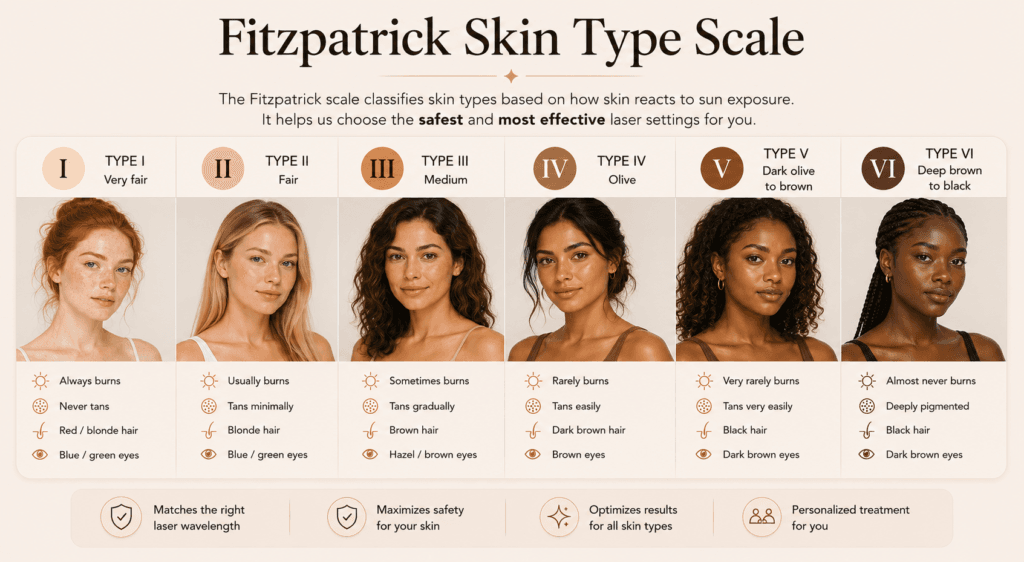
Determine your Fitzpatrick skin type
| Fitzpatrick | Description | Easily burns in the sun | Tanning in the sun | Recommended laser |
|---|---|---|---|---|
| 1 | Very fair, freckles, red/blonde hair | Always | Never | Alexandrite |
| 2 | Light, easy to burn | Always | A little | Alexandrite or Diode |
| 3 | Medium light | Sometimes | Yes | Alexandrite or Diode |
| 4 | Olive tone, rarely burned | Rarely | Very | Nd:Yag, Alexandrite Moveo, Diod |
| 5 | Dark olive/brown | Very rarely | Very | Nd:Yag, Alexandrite Moveo, Diod |
| 6 | Very dark/black skin | Never | Very | Nd:Yag |
Determine your hair color and texture
Lasers require pigment (melanin) in the hair shaft to work. This means that:
- Dark brown to black hair: All three laser types work great.
- Medium brown hair: Works, but requires more treatments.
- Light brown hair. Alexandrite works, limited effect with others.
- Blonde hair. Only Alexandrite has the potential to give results.
- Red, gray, white hair: Does not contain melanin – no laser works. Electrolysis is then the only option.
Consider the season and sun exposure
If you are tanned, Nd:Yag or Alexandrite Moveo are the only safe choices, regardless of your normal skin tone. Many clinics that only have Alexandrite or Diode have to postpone your treatment during the summer months. A clinic with Nd:Yag or Moveo can treat all year round.
How many treatments do you need?
Hair grows in three phases: anagen (growth), catagen (transition) and telogen (resting). Lasers only work during the anagen phase, and at any given time 15-30% of hair is in that phase. Therefore, multiple sessions are required, approximately 4-10 weeks apart.
Average number of sessions for 80-90% hair reduction:
| Area | Sessions | Gap |
|---|---|---|
| Face | 8-12 | 4-5 weeks |
| Armpits/Intimate | 6-10 | Armpits/Intimate |
| Rest of the body | 8-12 | 8-10 weeks |
Factors that affect the number of sessions: hormones (PMOS, hirsutism and pregnancy increase the number), genetics, hair color, hair thickness, and your laser type in relation to your skin tone. It is important to know that when we are born we all have the hair follicles that we are supposed to have. They lie dormant in the skin and the body then sheds them during our lifetime.
Safety and side effects
Temporary side effects are common and usually mild:
- Redness and swelling around the hair follicles (hours to a few days)
- Mild irritation or feeling of warmth
- Temporary skin or hair texture change
More rare risks but which occur from time to time:
- Hyperpigmentation (browning) – especially with Alexandrite on darker skin
- Hypopigmentation (light spots) – rare, usually with darker skin.
Hyperpigmentation can last for a longer time, on dark skin up to a year, but they basically always disappear.
Very rare risks, usually with the wrong laser choice or wrong settings:
- Burns or blisters – almost always linked to the wrong laser choice
- Paradoxical hair growth – an unusual phenomenon where the laser stimulates more hair in marginal zones, most commonly on the factor.
The most important safety factor is that the clinic has the right laser for your skin type, not that they “adjust the settings” on a laser that is wrong from the start.
How to choose a clinic
- Ask what lasers they have. A clinic that says “laser” without specifying is not being honest. Demand to know exactly which machines and wavelengths are available.
- Demand that they have at least two types of laser. With only one type of laser, the clinic is forced to treat all clients with the same machine, whether it is optimal or not.
- Ask for a free consultation.
- Ask about the training of the staff. Certified therapists with training in lasers are the minimum standard.
- Ask for realistic expectations. A clinic that promises 100% hair-free or “two treatments are enough” is not being honest.
Frequently asked questions
Is permanent hair removal really permanent?
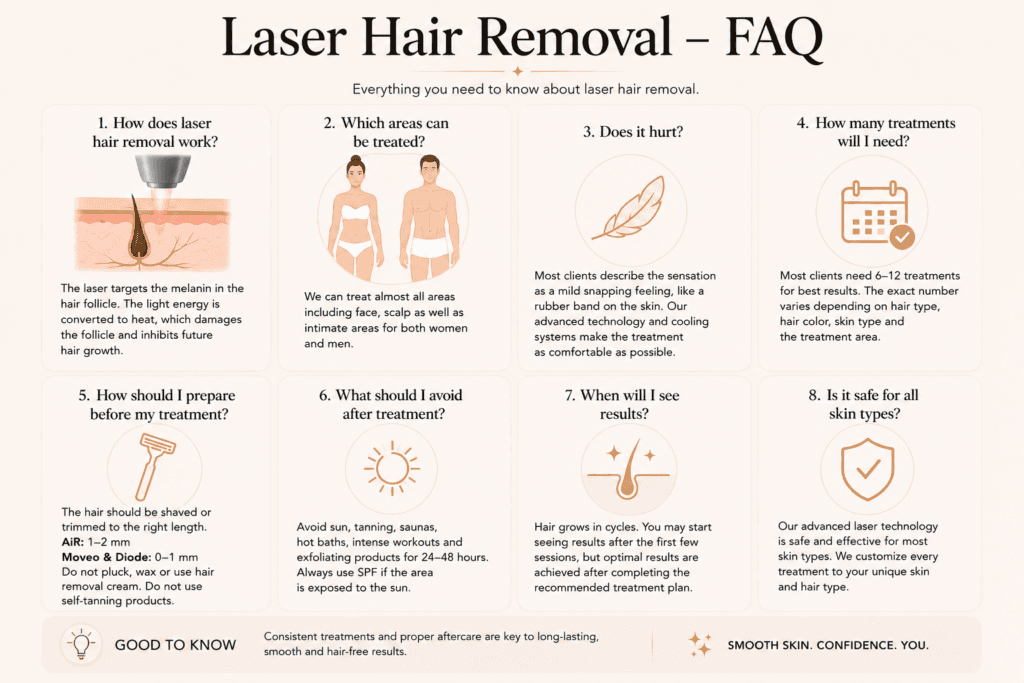
Lasers provide 80-90% permanent hair reduction. Technically, it is called “permanent hair reduction.” The hairs that remain are usually much finer and lighter. Only electrolysis is classified by the FDA as completely permanent hair removal.
Which laser is best for permanent hair removal?
It depends on your skin tone and hair color. Alexandrite lasers are most effective for light skin with dark hair, Nd:Yag is safest and most effective for darker skin tones.
How is Alexandrite lasers different from Yag lasers?
Alexandrite lasers (755 nm) work at a shorter wavelength and are most strongly absorbed by melanin in the hair follicle. This makes them especially effective on light skin with dark hair. Nd:Yag (1064 nm) has the longest wavelength, penetrates deeper and is less absorbed by melanin in the skin – making it the safe choice for darker skin tones and tanned skin.
How many treatments do I need?
Typically 6-12 treatments for 80-90% hair reduction, depending on area, hormones and hair texture. Maintenance treatments 1-2 times a year may be needed for some while others may wait several years before a touch-up is needed.
Is laser safe on dark skin?
Yes, if the right laser is used. Nd:Yag laser is safe even on Fitzpatrick VI (very dark skin). Alexandrite AiR and Diode are not safe on the darkest skin types. Always ask the clinic to specify which laser they use for your skin.
Does laser work on white, red or grey hair?
No. Laser requires melanin in the hair shaft to work. Red, grey and white hair contain too little melanin. Electrolysis is then the only option for permanent hair removal.
Can I have laser in the summer or if I am tanned?
With Alexandrite laser or Diode laser: no, wait until the burn has subsided. With Nd:Yag laser: yes, it is safe even on tanned skin. There is a big advantage with clinics that have Nd:Yag. Moveo also works on tanned skin. However, you should always avoid sunbathing 2-3 weeks before and after your laser session.
Does laser hurt?
The feeling is often described as a quick rap or a rubber band snap. Modern lasers have cooling systems (cold air, contact cooling or cryogenic spray) that make the treatment much more comfortable. Moveo is often experienced as the least painful, but Diode lasers are also considered a “kind” treatment. Nd:Yag is in between. Alexandrite AiR is the strongest.
How much does permanent hair removal with laser cost?
The price depends on the area and number of sessions. A complete treatment series typically costs 5,000–25,000 SEK depending on which area is lasered.
What is the difference between IPL and laser?
Laser is monochromatic (a specific wavelength, e.g. 755 nm) and concentrated. IPL is polychromatic (multiple wavelengths at the same time) and diffuse. Laser provides 80–90% hair reduction, IPL provides 50–70%. IPL requires more treatments and gives weaker results.
Can men have permanent hair removal?
Yes. All areas are treated: back, chest, stomach, shoulders, arms, legs, face, scalp and intimate areas. Men often have coarser and more hormonally influenced hair, which may require more sessions and maintenance treatments.
What is paradoxical hair growth?
An unusual phenomenon where laser in the marginal zone around the treated area stimulates fine hair to become darker and coarser, rather than disappearing. Most common on the face in women with hormonal hair growth. Treated by expanding the treatment zone.
About A Beauty Light
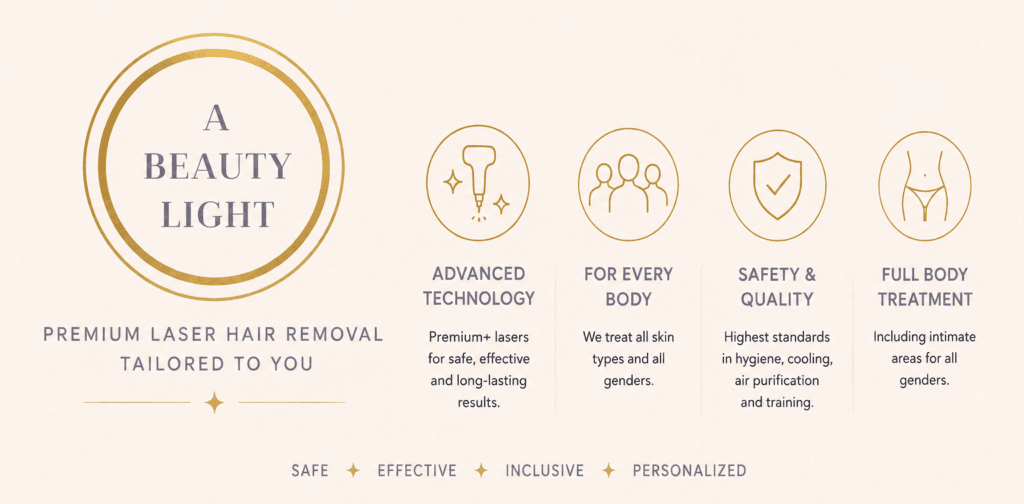
A Beauty Light is a laser clinic on Södermalm in Stockholm specializing in permanent hair removal. We have several laser types on site: Alexandrite AiR, Alexandrite Moveo, Nd.Yag AiR and Nd:Yag Moveo, which allows us to adapt the treatment to each individual’s skin tone and hair type – instead of forcing all customers into the same technique.
We work with a Premium+ laser, DEKA Again Pro Plus, the highest standard in laser hair removal. We maintain the same high standards of cooling, air purification, UV marking, hygiene and of course training and insurance.
We treat the whole body including intimate areas for women, men, transgender people and non-binary people. Book a free consultation where we do a skin analysis, go through your expectations and suggest the laser type that suits you best.
Sources and references to terms used in this article: Fitzpatrick skin type classification (Fitzpatrick, T.B., 1988); permanent hair reduction definition (FDA classification of laser hair removal devices); melanin absorption spectra for 755, 810 and 1064 nm wavelengths (Anderson & Parrish, theory of selective photothermolysis, 1983).