

Everything you need to know before you start laser hair removal
Laser hair removal has become one of the world’s most popular treatments for long-term hair reduction — but there are still many misconceptions about how lasers actually work. Many people believe that all lasers are the same, that results are immediate, or that the treatment works equally well on all skin and hair types.
The truth is that results depend on several factors:
- the type of laser used
- how experienced the therapist is
- your skin tone and hair type
- your hair type
- whether the clinic is actually using the right technique for the right person
In this guide, we’ll go over exactly how laser hair removal works, why multiple treatments are needed, how different hair types react to lasers, and what to consider before and after your treatment.
What is laser hair removal?
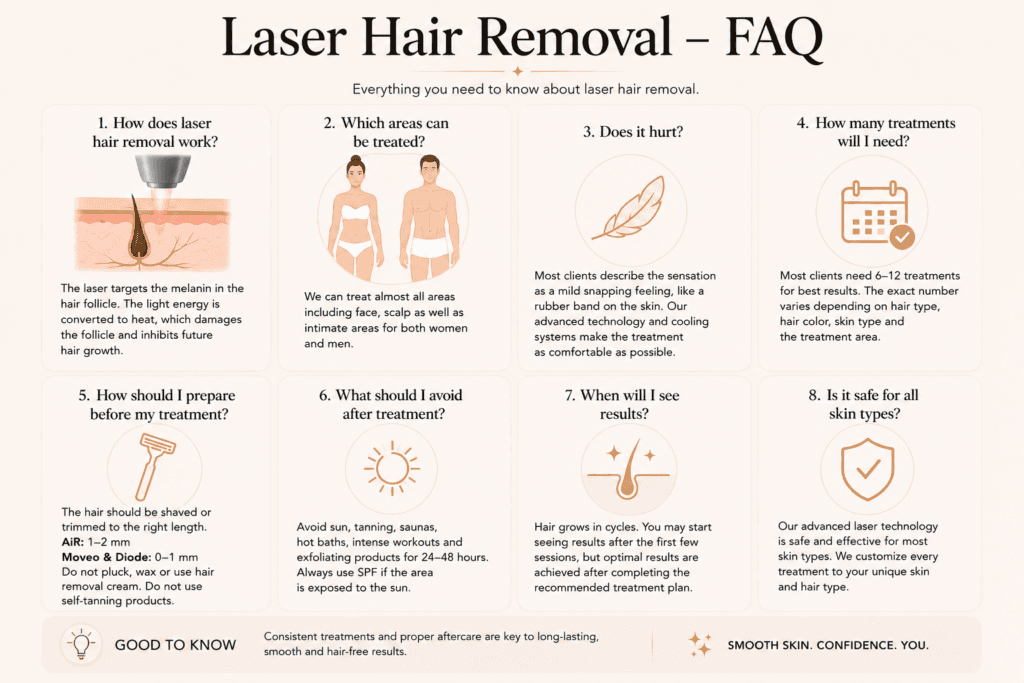
Laser hair removal is a medical treatment that uses concentrated light to heat and destroy the hair follicle. The light travels to the melanin (pigment) in the hair shaft and is converted into heat that is conducted down to the root of the hair.
When the hair follicle is damaged enough, hair production is reduced or stopped permanently.
Unlike shaving, waxing, or epilation, lasers treat the cause of hair growth — the hair follicle — rather than just removing the hair above the skin.
How does laser work technically?
All laser hair removal is based on the same basic principle:
- The laser light is directed at the skin
- The pigment in the hair absorbs the energy
- The energy is converted into heat
- The heat damages the hair follicle
- The hair stops growing or becomes thinner and sparser
This is called:
selective photothermolysis
This means that the laser tries to heat the hair follicle without damaging the surrounding skin.
That is why the contrast between skin and hair is important. Dark hair contains a lot of melanin and absorbs energy effectively, while white, gray and red hair lacks enough pigment to be treated with laser.
Lasers not only work differently on hair color and thickness – but also on hair type
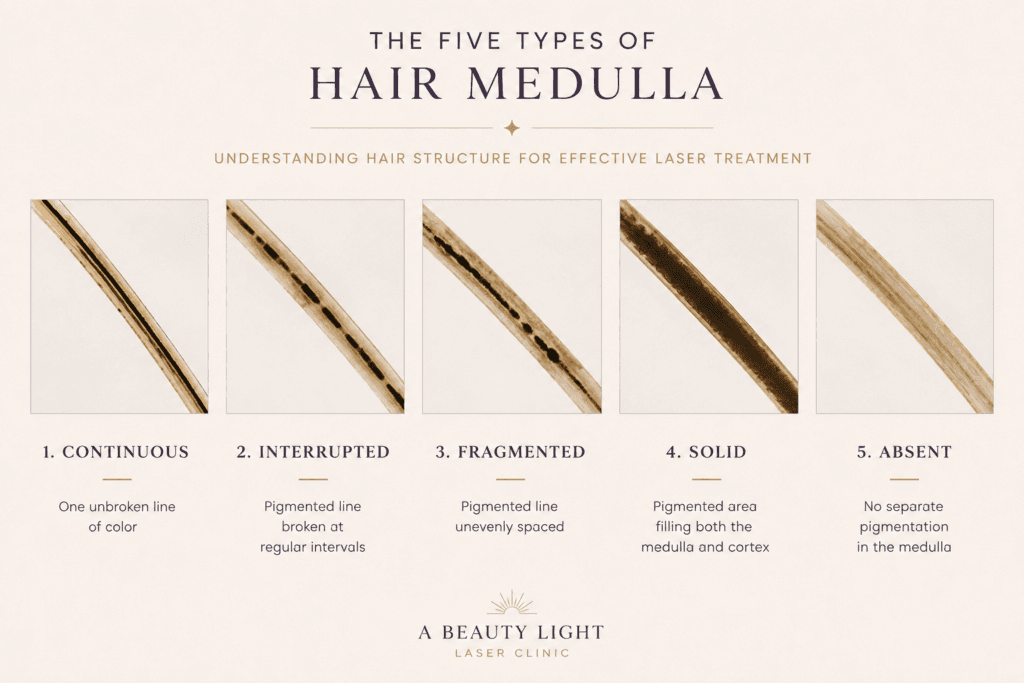
There is another parameter that affects whether laser works on your hair growth:
How the hair shaft is structured inside.
In laser hair removal, the energy is carried down to the hair follicle through the pigment strand in the hair — also called:
medulla
The medulla acts as a “transport route” for the laser energy down to the root. Its appearance varies between different hair types — and it affects how easy or difficult the hair is to treat.
The five types of medulla
1. Continuous medulla
The pigment strand goes all the way down to the root without interruption.
Results
These hairs are usually very easy to treat because the energy is conducted effectively all the way down to the hair follicle.
2. Interrupted medulla
The pigment strand is interrupted at regular intervals.
Results
Can be more difficult to treat if pigment is missing near the root because the laser then does not make as good contact with the hair follicle.
3. Fragmented medulla
The pigment strand is uneven and interrupted without clear symmetry.
Results
May give varying results depending on how much pigment remains near the root.
4. Solid medulla
Here the pigment also leaks into the cortex, which means that almost the entire hair shaft is pigmented.
Results
This is often the absolute best hair type for laser hair removal. The laser makes maximum contact with the hair shaft and can deliver very effective energy down to the hair follicle.
5. No medulla
Red, gray, white and some very light hairs lack a pigment strand.
Results
These hairs cannot be treated with laser because there is no melanin to absorb the energy.
In these cases:
electrolysis/diathermy
is the only permanent option.
Why are multiple treatments needed?
One of the most common questions we get is:
“Why isn’t one treatment enough?”
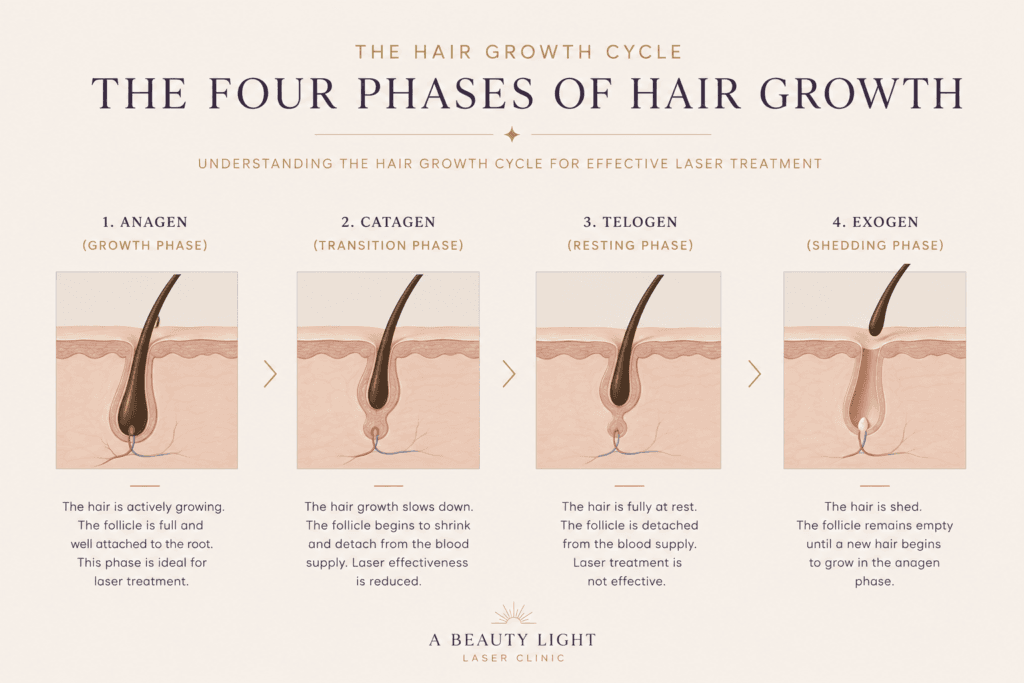
The answer is that hair grows in different phases.
The three growth phases of hair
1. Anagen phase – active growth phase
It is only in this phase that the hair follicle is connected to the blood supply and contains enough pigment for the laser to work optimally.
2. Catagen phase – transition phase
The hair is being released from the hair follicle.
3. Telogen phase – resting phase
The hair is resting and will later fall out.
Since only about 15-20% of hairs are in the active growth phase at the same time, the treatment must be repeated several times to hit all the hairs at the right time.
How many treatments are needed?
It varies depending on:
- area
- hormones
- skin type
- hair type
- genetics
- gender
- which laser is used
Generally needed:
| Area | Typical number of treatments |
|---|---|
| Face | 8–12 |
| Armpits | 6–8 |
| Bikini/intimte | 6–10 |
| Legs | 6–10 |
| Back/breasts | 8–12 |
Hormonally affected areas often require more treatments and sometimes maintenance over time.
Hair growth changes throughout life
When we are born, we already have all the hair follicles we will have during our lifetime. Many of these lie dormant in the skin and the body activates them gradually throughout life.
It is affected by, among other things:
- hormones
- genetics
- age
- testosterone
- pregnancy
- PMOS (PCOS)
- medications
- supplements and hormones
Puberty changes hair growth
When we enter puberty:
- armpit hair becomes coarser
- intimate hair develops
- boys grow beards
Hormones greatly affect hair growth
High testosterone production and hormonal conditions can:
- increase hair growth
- activate dormant hair follicles
- make hair coarser and darker
Pregnancy and PMOS can stimulate hair growth on:
- face
- tummy
- breast
- chin
- neck
Hair growth also changes with age
In women:
- more hair on the upper lip and chin
In men:
- more hair on the nose and ears
- more hair on the shoulders and upper back
In general, hair can also become:
- coarser
- longer
- harder
Therefore, maintenance treatments are sometimes needed
Laser can permanently reduce the hair that is active at the time of treatment — but it cannot prevent the body from later activating new dormant hair follicles.
That is why many people choose:
- maintenance treatments 1–2 times a year
- or touchups as needed over time
This does not mean that the treatment has failed — but that the body changes throughout life.
Does laser hair removal hurt?
This depends a lot on:
- which laser is used
- which cooling the clinic has
- the area being treated
- hair density and thickness
- your own pain threshold
Many describe the feeling as small flicks or a rubber band against the skin.
Modern premium lasers, together with powerful cooling, however, make the treatment significantly more comfortable than older systems.
Sensitivity by area
| Area | Experience |
|---|---|
| Legs & arms | Mild |
| Back | Mild–medel |
| Armpits | Medium |
| Bikini/intimate | More sensitive but fully manageable |
| Face | Short-term stinging |
| Beard growth | Intensive |
| Scalp | Intensive |
Dense and coarse beard growth is often one of the most intensive treatments in laser hair removal. The scalp can also be experienced as sensitive because the skin there is thin and rich in nerves.
Despite this, most people find the treatment to be fully manageable — especially since each pulse only lasts a very short time.
Many also find that the results outweigh the temporary feeling, especially if you have been bothered for a long time by:
- excessive hair growth
- irritation after shaving
- ingrown hairs
- beard rash
- persistent stubble
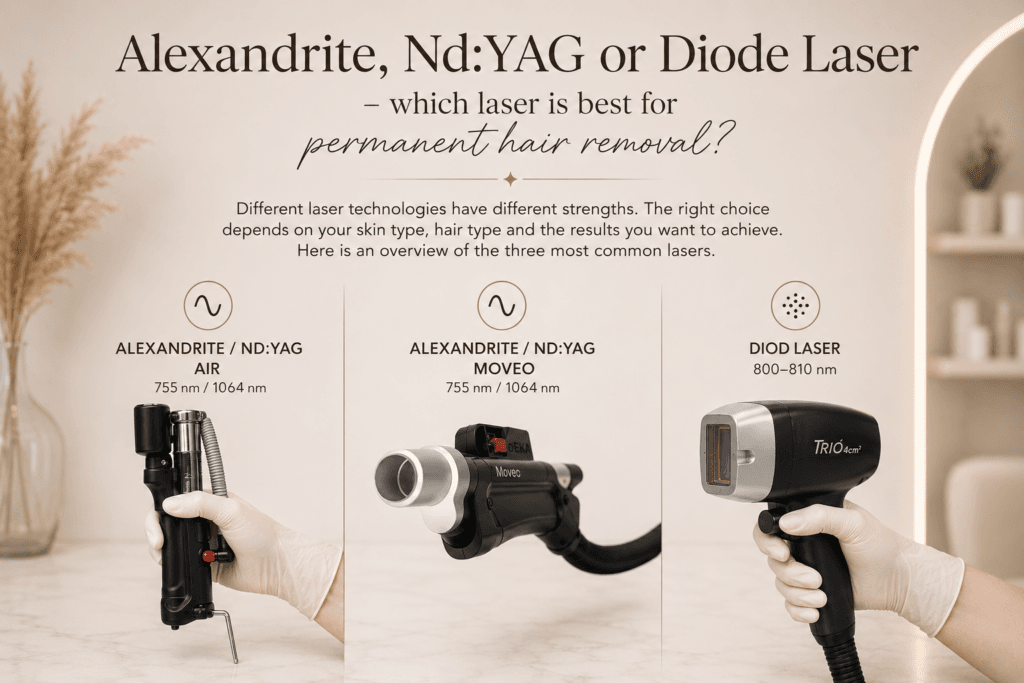
What are the different types of lasers?
This is the part that many clinics simplify — even though it is one of the most important factors for results and safety.
Alexandrite laser (755 nm)
Alexandrite has very high absorption in melanin, which makes it extremely effective on dark hair.
Advantages
- Very effective on light skin
- Fast results
- Good on thinner hair
Disadvantages
- Requires the right settings on darker skin
- Less optimal on very tanned skin
Diode laser (800–810 nm)
Diode lasers are between Alexandrite and Nd:YAG in wavelength.
Advantages
- Works on many skin types
- Common technology on the market
Disadvantages
- Quality varies enormously between different machines
- Many low-cost lasers use diode technology
Nd:YAG laser (1064 nm)
Nd:YAG has a longer wavelength and penetrates deeper into the skin.
Advantages
- Safest on darker skin types
- Good for coarse hair
- Lower risk of pigment changes
Disadvantages
- Lower melanin absorption than Alexandrite
Why does the laser type matter so much?
Not all customers have the same:
- skin tone
- hair thickness
- hair color
- hormone levels
- sensitivity
Therefore, it does not work:
“one laser for all”
A reputable clinic should be able to adapt:
- wavelength
- energy
- pulse time
- cooling
- technique
to each individual.
Is laser suitable for all skin types?
Modern premium lasers can treat most skin types — even darker skin tones — if the right technique is used.
The most important thing is:
- correct skin analysis
- correct wavelength
- experienced therapist
- safe energy level
The wrong laser or the wrong settings can increase the risk of:
- burns
- pigment changes
- poor results
How to prepare for treatment?
For best results, the skin and hair need to be prepared correctly.
Important before treatment
- Shave or trim the area according to the clinic’s instructions
- Avoid sunbathing and sunless tanning
- Do not wax, pluck or use hair removal cream
- Avoid strong acids and retinol on the area
- Inform about medications and skin products
It must be hair in the hair follicle for the laser to work.
What happens after treatment?
It is normal for the skin to be:
- warm
- slightly red
- sensitive for a few hours
Some people get small swellings around the hair follicles – this is often a good sign.
Aftercare
Avoid:
- exercise the first day
- sauna and hot baths
- direct sun
- exfoliation for a few days
Always use SPF on treated areas that are exposed to the sun.
When do you see results?
Many people notice a difference after the first treatment.
Common signs:
- hair grows slower
- hair becomes thinner
- some areas become hairless in patches
After 3-4 treatments, the difference usually becomes clear.
The final result comes gradually during the treatment period.
Are the results permanent?
Laser provides permanent hair reduction — not always 100% permanent hair freedom.
Most people get:
- greatly reduced hair growth
- thinner hair
- long-lasting smooth areas
Some dormant hair follicles can be activated by:
- hormones
- pregnancy
- medications
- age
- genetics
That’s why many people choose to have maintenance treatments over time.
Is laser hair removal safe?
Yes — when the treatment is performed with medical equipment by trained personnel.
Safety is affected by:
- the right laser
- the right settings
- hygiene
- cooling
- experience
There is a big difference between different clinics and different machines.
A Beauty Light – advanced laser hair removal in Stockholm
A Beauty Light is a laser clinic on Södermalm in Stockholm specializing in permanent hair removal with several different laser types on site.
We work with:
- Alexandrite AiR
- Alexandrite Moveo
- Nd:YAG AiR
- Nd:YAG Moveo
This allows us to adapt the treatment to each individual’s skin tone and hair type — instead of using the same technique on everyone.
We work with the Premium+ laser DEKA Again Pro Plus along with advanced cooling, air purification, UV labeling and high hygiene and safety procedures.
We treat the entire body including intimate areas for women, men, transgender people and non-binary people.
Summary
Laser hair removal is one of the most effective methods for long-term hair reduction — but the results are greatly influenced by:
- the technology used
- your skin type
- your hair type
- how experienced the clinic is
By understanding:
- how laser works
- why multiple treatments are needed
- how hormones affect hair growth
- why some hair is easier to treat than others
you can make a safer and smarter choice for your treatment.
With the right laser, the right settings, and the right practitioner, laser hair removal can produce very good and long-lasting results on most skin and hair types.